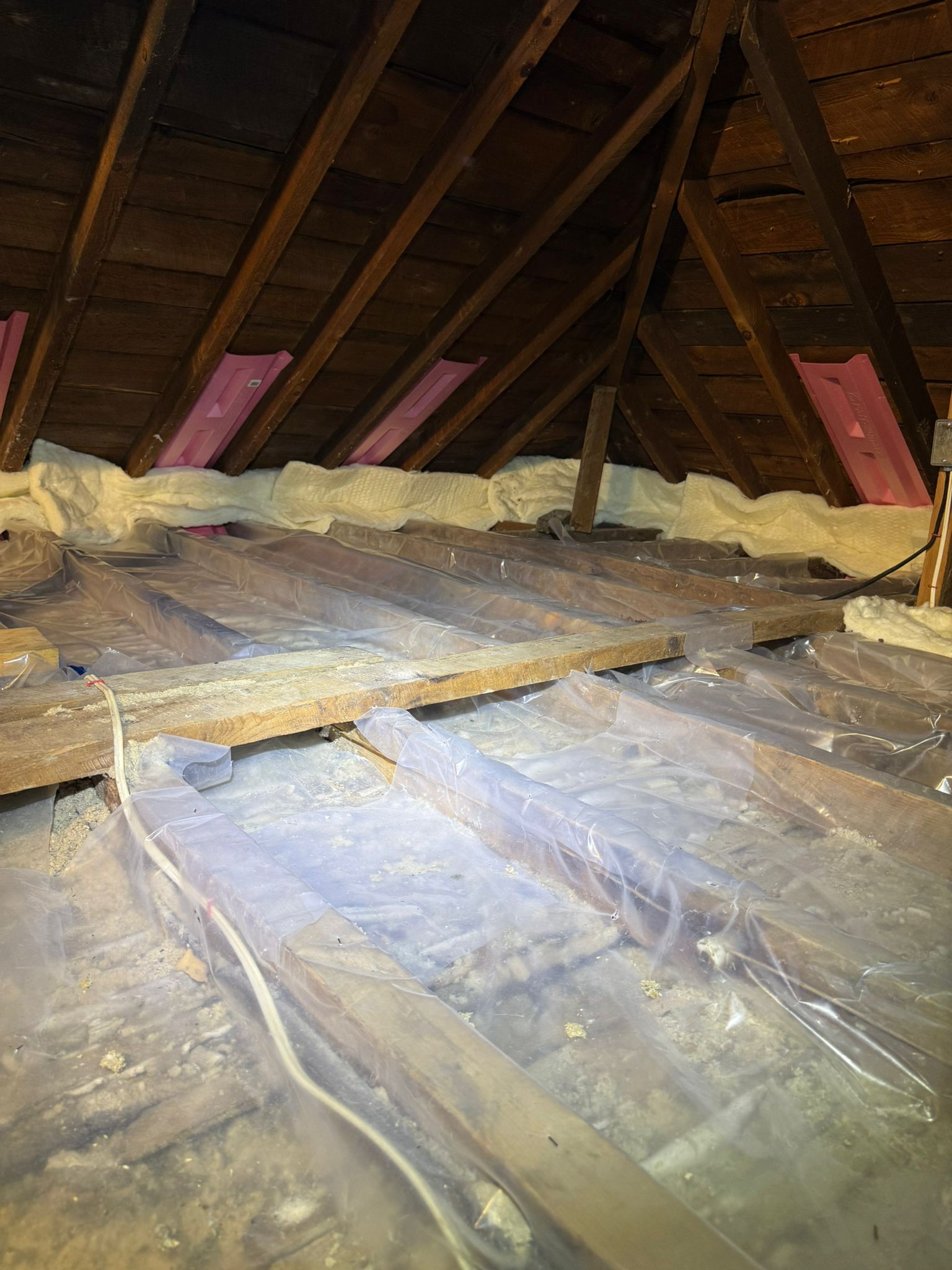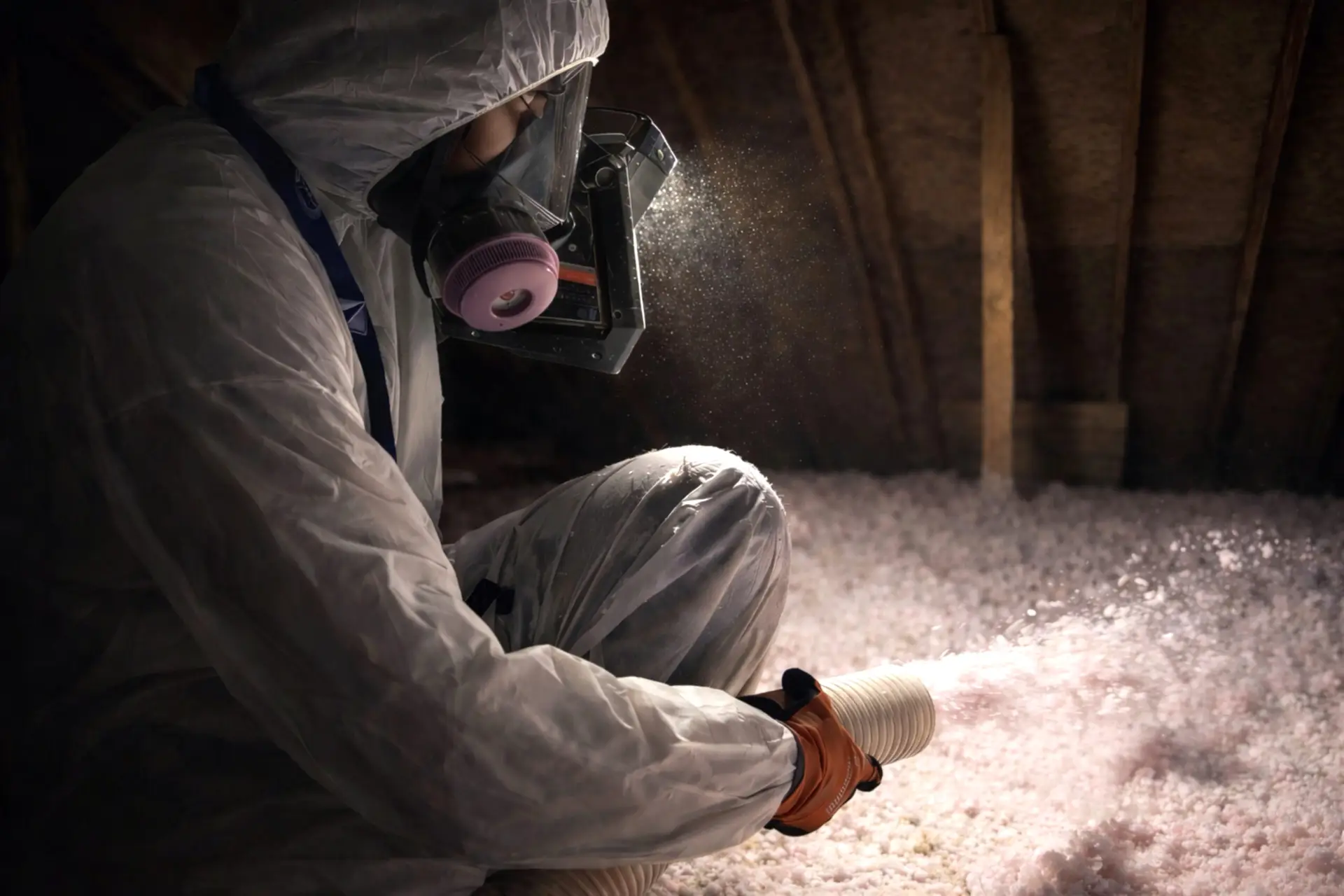
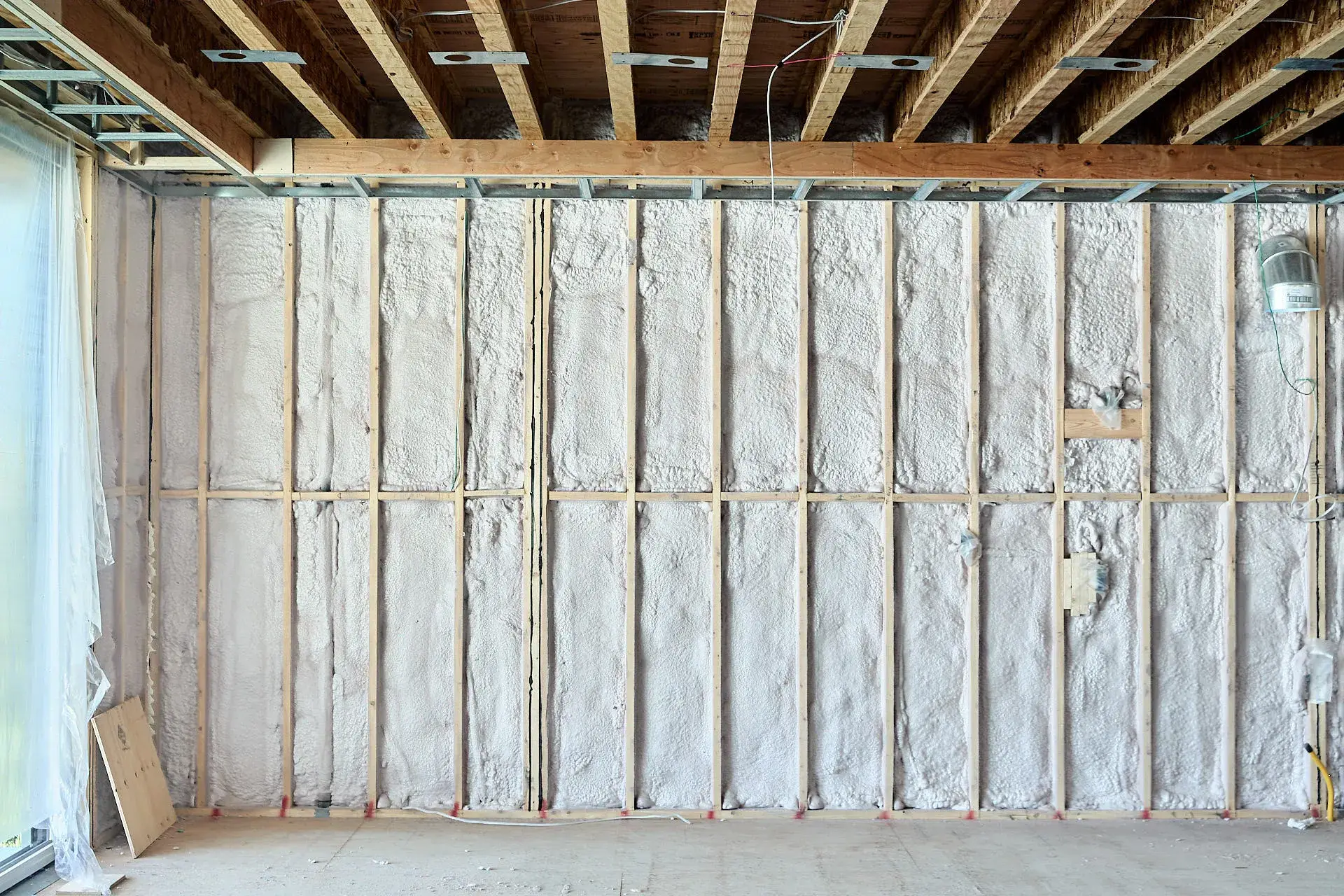
Most insulation problems have a cheaper solution than spray foam. If you have a standard truss attic with room to work, blown-in cellulose or fibreglass will get you to R-60 for meaningfully less money, and we’ll tell you so.
But a lot of Toronto housing doesn’t have a standard truss attic. It has a flat roof over a rear addition, a cathedral ceiling in a third-floor conversion, a basement that was underpinned two owners ago, and a rim joist that has never been sealed in a century.
Those are the assemblies where spray foam isn’t the premium option — it’s the only one that works properly. Here’s why, and what to ask about before you book.
First, the one distinction that determines your quote
There are two spray foam products and they do different jobs. Any quote that just says “spray foam” isn’t comparable to another quote that says the same thing.
| ½ lb open-cell | 2 lb closed-cell | |
|---|---|---|
| Approx. R per inch | ~R-3.5 – R-3.8 | ~R-6.0 – R-7.0 |
| Structure | Soft, flexible | Rigid, dense |
| Own vapour barrier? | No | Yes, at sufficient thickness |
| Handles moisture | Absorbs water | Resists water |
| Sound dampening | Better | Poorer |
| Relative cost | Lower | Higher |
Everything in this article is closed-cell except where noted. Below grade, in a tight cavity, or against a cold exterior assembly, closed-cell is what the application requires — the R-value per inch and the moisture performance are both doing necessary work.
Open-cell has a real place in Toronto housing, but it’s mostly interior: party walls in semis, sound between floors in a converted duplex, and interior partitions in a renovation.
½ lb low-density → · 2 lb high-density →
Assembly 1: The flat or low-slope roof
Rear additions, rowhouse roofs, and a great many Toronto semis have a flat or shallow-pitch roof. There’s no attic. There’s a joist cavity, a roof deck, and a membrane — often with only 6 to 9 inches to work with.
Why conventional insulation struggles here:
- There’s rarely enough depth to reach a high R-value with batts or loose fill
- These assemblies usually have little or no ventilation path, so any moisture that gets in has nowhere to go
- Batts sag away from the deck over time, leaving a gap where warm air convects
Why closed-cell works: at roughly R-6 to R-7 per inch, it delivers far more thermal performance in the depth available. It adheres directly to the underside of the deck with no gap, and at sufficient thickness it controls vapour itself — which matters enormously in an unvented assembly.
Worth knowing before you budget: flat roofs and low-slope assemblies are a separate category under Ontario’s rebate program, with different R-value thresholds and different rebate amounts than a standard attic. The thresholds are lower — which is realistic, given the depth constraint. Details in our Toronto rebate guide →
Sequencing note: if the roof membrane is near end of life, do the roof first. Foaming the underside of a deck that’s about to be torn off is money spent twice.
Assembly 2: The cathedral or vaulted ceiling
Third-floor conversions, loft-style renovations, and open-beam additions all have the same constraint: the finished ceiling follows the roofline, so the insulation has to fit between the rafters, and there isn’t much room.
Same logic as the flat roof. When cavity depth is fixed, R-value per inch is the entire game, and closed-cell foam roughly doubles what you get from the same inches of batt.
The other advantage is continuity. A cathedral ceiling has rafters every 16 or 24 inches, and every one of those is a thermal bridge and a potential air leak at the edges. Batts leave gaps at every rafter face. Foam doesn’t.
Assembly 3: The basement — especially an underpinned one
Basement lowering and underpinning is common across Toronto’s older housing, and the finished result creates a specific insulation problem: new concrete, an unfinished perimeter, and an owner who wants to frame and finish the space.
The thing people get wrong: framing the wall, filling it with fibreglass batts, and drywalling over it.
Foundation walls in Toronto’s older housing move moisture. The soil is against them, they’re often rubble stone or older poured concrete, and even a well-waterproofed wall has some vapour drive. Fibreglass holds that moisture against the framing, and three or four winters later there’s mould behind the drywall that nobody can see.
Closed-cell foam applied directly to the foundation wall insulates and controls vapour in one operation, with no gap for moisture to condense in. You then frame in front of it and finish normally.
Two related items in the same visit:
- Basement slab and rim joist — often the cheapest remaining gains once the crew is on site
- Vapour barrier strategy — depends on the assembly. We specify it on the quote rather than defaulting to poly everywhere, because poly in the wrong place traps moisture instead of stopping it. Vapour barrier installation →
Rebate note: basement wall and crawlspace insulation carry their own rebate amounts under the program’s bundled path — meaningfully more than the attic in some cases.
Assembly 4: The rim joist in a century home
The rim joist is the band of framing around the top of your foundation, where the floor structure sits on the wall. In a house built in 1915, it has probably never been sealed. Often there’s a scrap of fibreglass shoved in, or nothing.
It’s a small area with an outsized effect. Cold air enters here, travels through the floor structure, and shows up as a cold first floor and a draughty basement. Closed-cell foam seals and insulates it in one pass.
It’s also usually the cheapest qualifying upgrade available if you’re pursuing the bundled rebate path and need to reach the two-upgrade minimum.
Where we’ll tell you not to use spray foam
Being straight about this is more useful than selling you the expensive product.
A standard attic with headroom. If you have a truss attic and 18+ inches of clearance, blown-in gets you to R-60 for less. We install both. Attic insulation in Toronto →
Interior partition walls where the goal is quiet, not warmth. Acoustic mineral wool typically performs better for sound at lower cost. Safe and Sound →
As a fix for something that isn’t an insulation problem. Ice dams caused by blocked soffits, a hot upstairs caused by undersized ductwork, a damp basement caused by grading and downspouts — foam won’t solve any of those. A proper assessment finds the cause before recommending a product.
Over a roof deck with an active leak. Fix the leak first. Foam will hide it, not stop it, and it makes the eventual repair much harder.
Practical questions
Do I need to leave the house during installation? We install Insulthane Extreme by Elastochem and residents can generally remain in the home. We’ll discuss ventilation and re-entry timing for the specific area being sprayed, and if anyone in the household has significant respiratory sensitivities, tell us in advance so we can plan around it.
Can spray foam be removed later? Not easily — it bonds permanently. That’s a reason to be confident about the application before committing, particularly on a roof deck.
Does it need a separate vapour barrier? Closed-cell acts as its own at sufficient thickness. Open-cell generally does not. It’s assembly-specific and it will be stated on your quote.
Will spray foam make my old house too airtight? This is a fair question and the honest answer is that it depends on your ventilation. A house sealed properly without any mechanical ventilation can develop humidity and air-quality issues. If we’re air-sealing significant portions of an older home, ventilation is part of the conversation, not an afterthought.
Does spray foam qualify for the Ontario insulation rebate? Rebates are based on the R-value increase achieved and the area covered, not on the material used. Spray foam qualifies where it meets the thresholds for that assembly. Note the rebate is capped at a percentage of project cost, which changes the arithmetic on a higher-cost material. Read the rebate breakdown →
⚠️ Program terms change — confirm at homerenovationsavings.ca.
How we quote
- On-site assessment. We look at the actual assembly. No phone quotes on foam.
- The quote states the product and the applied thickness — open-cell or closed-cell, and how many inches. This is what makes competing bids comparable.
- Fixed price, quoted up front.
- If foam is the wrong call, we say so and quote the alternative. We install blown-in, batt, drill and fill and mineral wool too, so we have no reason to push the expensive option.
📞 (416) 315-0471 · Book a free assessment →