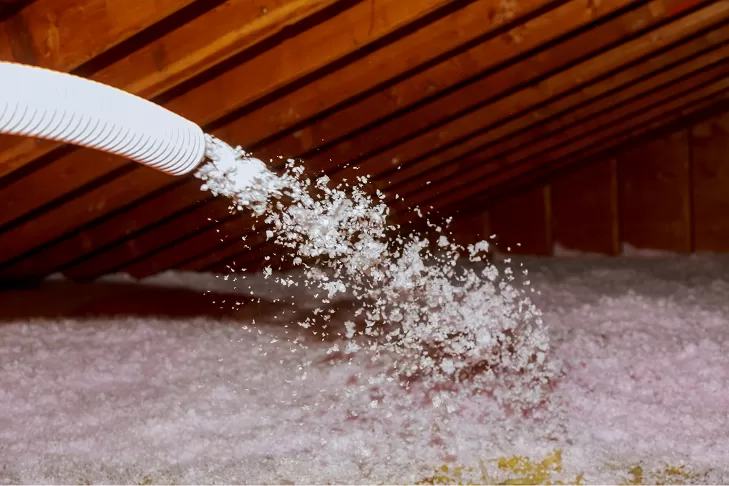

Walk down almost any street in Riverdale, Leslieville, the Annex, or High Park and you’re looking at a home that’s 90, 100, sometimes 120 years old. Solid brick, tall windows, a roofline with real character — and, more often than not, an attic that has never been properly insulated since the day the house was framed.
That’s the retrofit challenge specific to Toronto. It isn’t the same job as insulating a 20-year-old attic in a suburban subdivision with a simple truss roof and a flat, open floor. Toronto’s older neighbourhoods are full of Victorian and Edwardian semis and detached homes with dormers, additions bolted on over the decades, and roof lines that twist around bump-outs and bay windows. None of it was built with insulation in mind, because insulation standards as we know them didn’t exist yet.
Rooflines That Don’t Follow the Rulebook
A standard new-build attic is a straightforward space to insulate: open, accessible, one consistent roof pitch. A century-old Toronto attic is rarely that simple. Dormers create awkward low-slope pockets. Additions from the 1960s, 80s, or 2000s meet the original roof at odd angles, often with gaps where the two structures were never properly sealed to each other. Old chimneys and irregular framing add more obstacles. Getting consistent, code-level coverage in a space like this takes more judgment than rolling out batts in a rectangle.
This is exactly why it’s worth being selective about who you hire. Homeowners searching for attic insulation contractors in Toronto should look for a crew that has specifically worked on older housing stock — not just newer infill builds or condo towers elsewhere in the city, where the attic problem, if it exists at all, looks completely different.
What’s Probably Up There Right Now
In a lot of Toronto’s century homes, the attic has one of three things: nothing at all, a thin layer of old loose-fill that has settled to a fraction of its original depth, or insulation that was added decades ago and no longer meets current recommendations. None of this shows up on a walkthrough of the finished living space. The only way to know is to actually get up there and look — which is why a proper inspection, not a phone-quote guess, has to come first.
Where the Heat Actually Goes
An under-insulated attic in an old house doesn’t just waste energy — it changes what happens on your roof in winter. Warm air escaping from the living space below rises into the attic, warms the underside of the roof deck, and melts snow unevenly. That meltwater runs down to the colder eaves and refreezes, building the ice dams that show up on so many older Toronto roofs every January and February. Natural Resources Canada’s guide on roofs and attics lays out exactly how that warm-air leakage drives the problem — and why sealing air leaks before adding insulation matters as much as the insulation itself.
A Rebate That Makes the Timing Better
Ontario’s Home Renovation Savings program, run jointly by Enbridge Gas, Save on Energy (IESO), and the Ontario government, currently offers a $1,250 rebate for attic insulation upgrades — up from the previous $1,000. If you’re doing a standalone attic insulation project, you don’t need to book a home energy assessment first to qualify. That’s one less hurdle for a homeowner who just wants the attic done.
Why Century Homes Need a Contractor Who’s Seen This Before
Pro Insulation Contracting inspects the attic in person before quoting anything, because on a home this old, a number can’t be given honestly over the phone. We check for air leaks around chimneys, dormer walls, pot lights, and additions, and we seal those leaks before adding new insulation — not after, and not instead of. We also handle the rebate paperwork directly, so the $1,250 doesn’t get left on the table because a form went missing.
If your century home still has its original attic — or something close to it — contact Pro Insulation Contracting to get it properly inspected and quoted.